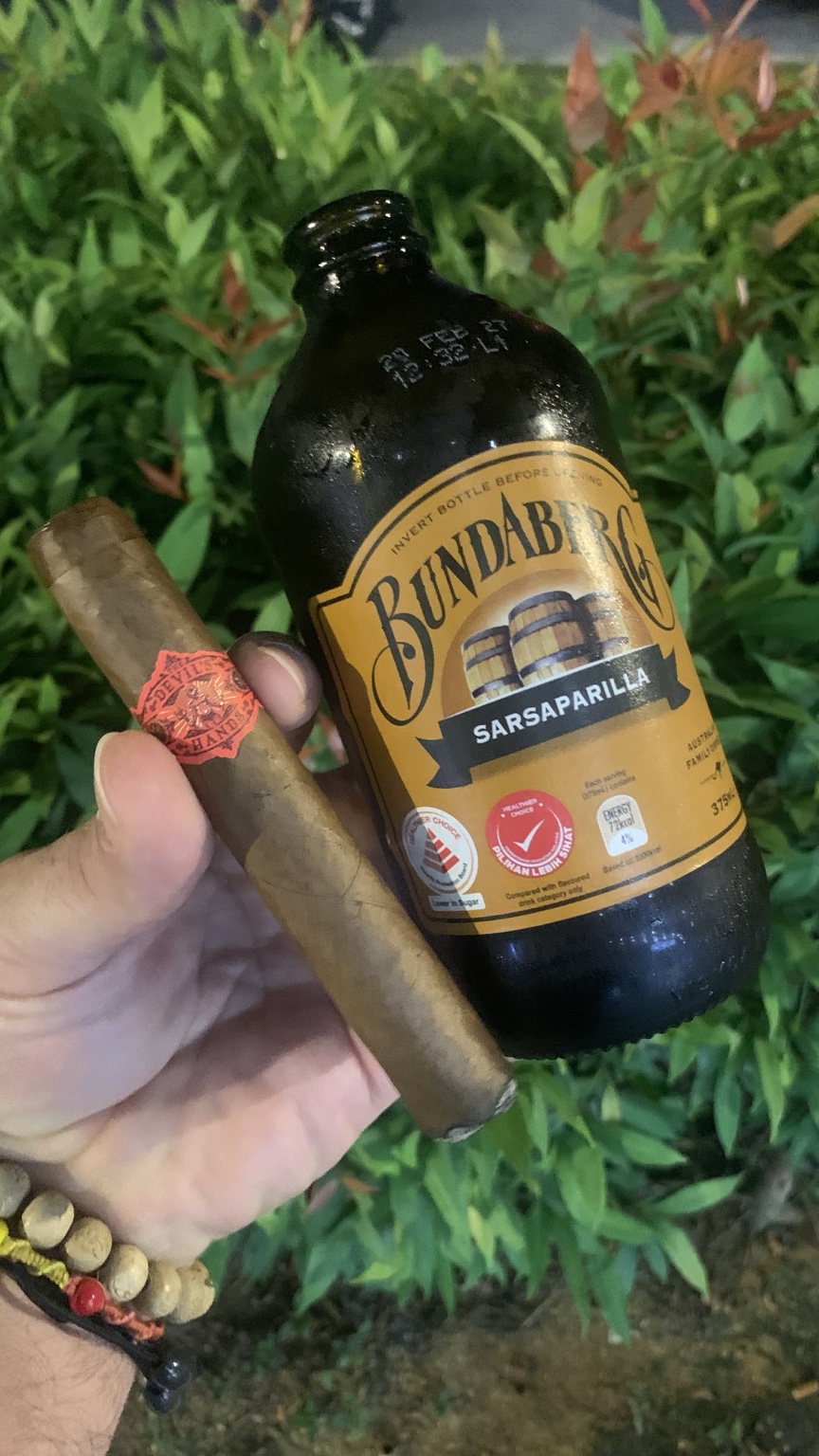
- Cigar
- Warped The Devil’s Hands
- Format
- 5 × 48
- Partner
- Bundaberg Sarsaparilla
It was close to 11 p.m. in Ampang, Kuala Lumpur. I had spent the evening at home with Alicia, and after she said goodbye, I decided to end the day with a cigar. Nothing ceremonial: gym shorts, T-shirt, flip-flops, and a seat outside NEU Suites.
The cigar was Warped The Devil’s Hands, 5 × 48, joined by a cold bottle of Bundaberg Sarsaparilla.
My last meal had been light—waffles with a little chocolate and peanut butter, eaten perhaps two and a half or three hours earlier. That turned out to be appropriate preparation. This is not a cigar I would necessarily put after a heavy meal. Its relatively delicate profile seems better suited to lighter food, perhaps toast, nuts, waffles, a restrained amount of chocolate, or something with just enough sweetness to complement the tobacco without burying it.
Before the flame
Before lighting, I always spend a moment with the cigar intact. It is a small ritual I consider essential: smelling the unlit body and taking the cold draw allows us to begin tasting the tobacco before combustion transforms it.
The unlit body of The Devil’s Hands carried an aroma reminiscent of a hay bale—dry, agricultural, unmistakably tobacco-driven. The cold draw moved further toward dry earth and aged tobacco, while the wrapper itself left a noticeable slickness of oil against the lips.
None of this guarantees what the cigar will become once lit. That is part of the pleasure. The pre-light ritual is less a prediction than an introduction: the cigar presenting itself before the flame begins changing it.
The cigar
From the first puffs, the profile was straightforward: toast, earth and spice, with almost no sweetness.
Through the retrohale, the spice gradually became easier to identify. It did not remind me much of black pepper. Instead, it had something closer to an earthy ginger quality.
That basic vocabulary remained remarkably consistent throughout the hour. The cigar evolved mostly by changing the prominence of its flavors rather than constantly introducing new ones. Spice moved forward and then retreated. Toast eventually became dominant. Earth remained underneath.
Brief darker accents appeared along the way: a touch of roast, a fleeting cocoa note, and later a slightly woody, oaky impression that reminded me of an old rum barrel—not rum itself, but the dry, dark wood of a barrel that might once have contained it.
These are impressions, not objective declarations. Another smoker may find something completely different.
Texture changed more noticeably than flavor. The wrapper became increasingly oily on the palate and, around the midpoint, developed the slightest creamy quality without losing the cigar’s fundamentally dry character.
Flavor began around medium and later settled closer to mild-to-medium. Nicotine strength also felt restrained. Whatever this cigar may have expressed when fresher, this particular example was approachable, clean and easy to smoke.
The pairing
The Bundaberg Sarsaparilla turned out to be the surprise of the evening.
Cold, it entered the palate with lively carbonation and an impression of ginger snap, quickly moving toward molasses and syrup before fading into liquorice, herbal roots and an almost medicinal character.
That sweetness supplied precisely what the cigar lacked.
The most interesting discovery came from changing the order of consumption.
Smoking first and drinking afterward worked well because the carbonation washed away the tobacco and reset the palate.
But sip first, then puff was considerably more rewarding.
Smoking while the molasses sweetness still lingered on the tongue seemed to extend sweetness through the next puff. The cigar itself did not suddenly become sweet. Rather, the drink prepared the palate for the smoke.
Ginger connected with the cigar’s restrained spice. Molasses filled an empty space in its otherwise dry profile. The herbal and medicinal qualities of the sarsaparilla gave the pairing another layer without becoming overpowering.
As the bottle warmed, the experience changed. Carbonation became less effective as a palate cleanser, while molasses, liquorice and herbal notes became more noticeable.
I drank it directly from the bottle. No glass, no ice. Dilution would probably have made the drink crisper, but it might also have weakened the syrupy molasses character that made the pairing so successful.
The informality suited the night.
Performance
Construction was very good. The burn was not perfectly razor-sharp, and it needed a few minor touch-ups, but nothing disrupted the experience.
The combustion rate felt appropriate—not particularly fast or slow—and smoke production was excellent.
In fact, the cigar produces enough smoke that it could tempt someone to puff too often. I deliberately smoked it gently. This is not a cigar that benefits from being rushed or overheated.
The final third brought the spice back upward along with a little bitterness as the cigar naturally became hotter. The darker woody accents disappeared, leaving mostly toast, earth and ginger-like spice.
It essentially said goodbye in the same language in which it had introduced itself.
One hour later
The cigar lasted roughly 58 or 59 minutes, so let’s call it an hour.
A faster smoker could probably finish it in 35 or 45 minutes, but I found no reason to rush it.
This is not an enormously complex cigar. Its attraction lies elsewhere: consistency, clean tobacco flavor, manageable strength, excellent smoke production, and small changes in texture and intensity that reward attention.
And simplicity is not a weakness.
Not every cigar needs to be opulent, powerful or constantly changing. Some cigars simply have a place and a time.
This one suited a quiet late night in Kuala Lumpur remarkably well.
The last sip of sarsaparilla left the palate sweet, herbal and slightly toasted.
A very simple pairing.
And a surprisingly successful one.